


Get a Quote
Establishing a steel factory demands meticulous attention to the foundation that will support heavy machinery—often weighing hundreds of tons and generating dynamic loads during operation. A poorly designed or improperly constructed foundation can lead to misalignment, excessive vibration, equipment damage, and even structural failure. For decision-makers and engineers involved in factory build-outs, understanding the precise requirements for steel factory foundations is critical to ensuring long-term operational reliability and safety. This article outlines the fundamental requirements, design considerations, and construction best practices, drawing on industry experience from HCGG, a trusted name in industrial foundation solutions.
A steel factory foundation must resist both static and dynamic loads. Static loads include the weight of the machine itself, the foundation block, and any ancillary equipment. Dynamic loads arise from rotating or reciprocating parts, impact forces, and thermal expansion. The foundation must transfer these forces to the ground without exceeding the soil’s bearing capacity or causing differential settlement.
Calculating the total static load requires summing the mass of the heaviest machine, the concrete foundation block, and any permanent attachments. For example, a 500-ton press requires a foundation mass typically 1.5 to 3 times the machine weight to ensure stability. HCGG recommends a minimum safety factor of 2.0 against overturning and sliding for all heavy machinery installations.
Machines that generate cyclic forces—such as rolling mills, forging hammers, and large compressors—require specialized dynamic analysis. The foundation’s natural frequency must be tuned to avoid resonance with the operating frequency range. Vibration isolation pads, spring mounts, or inertia blocks may be necessary. HCGG uses finite element analysis (FEA) to model soil-structure interaction and predict vibration amplitudes under operational conditions.
Before any concrete is poured, a thorough geotechnical investigation is mandatory. This includes soil borings, plate load tests, and laboratory analysis of soil properties such as cohesion, friction angle, and compressibility. The design of the foundation depth, type (spread footing, mat, or pile foundation), and reinforcement depends on these results.
The concrete used for heavy machinery foundations must meet stringent strength and durability standards. HCGG specifies minimum C30/37 concrete (30 MPa cylinder strength) for static loads and C35/45 for dynamic load areas. The mix design should incorporate low-shrinkage aggregates and a water-cement ratio below 0.45 to minimize cracking.
Steel reinforcement must be designed to control cracking from thermal and shrinkage stresses as well as to resist tensile forces from machine operation. Typical reinforcement ratios range from 0.5% to 1.5% of the concrete cross-section. Key areas include the base slab, machine pedestals, and anchor bolt zones. HCGG recommends using epoxy-coated rebar in corrosive environments and providing a minimum clear cover of 50 mm.
Heavy machinery is secured to the foundation via anchor bolts, which must be positioned with extreme accuracy—often within ±3 mm. Templates or pre-drilled steel plates cast into the concrete ensure alignment. The bolts must extend deep enough into the foundation to develop full tensile capacity, typically 30–40 times the bolt diameter. Grouting between the machine base and foundation ensures full contact and uniform load transfer.
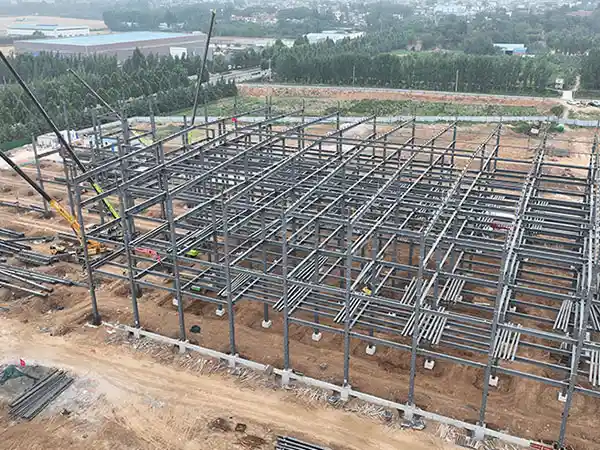
Proper execution during construction is as vital as design. The following steps are critical for a steel factory foundation:
HCGG deploys third-party testing including concrete cylinder compression tests (minimum 7 tests per 100 m³) and pull-out tests for anchor bolts to guarantee compliance with specifications.
Steel factories often operate in high-temperature zones near furnaces or in corrosive environments. Foundations in such conditions require heat-resistant concrete (using aggregates like crushed firebrick) and protective coatings against chemical spills. For extreme heat cycles, expansion joints must be placed every 10–15 m to accommodate thermal movement without cracking the foundation.
A successful steel factory foundation for heavy machinery is the result of rigorous geotechnical analysis, precise structural design, and meticulous construction. The foundation must manage static and dynamic loads, accommodate soil conditions, and maintain alignment over decades of operation. Engaging experienced partners like HCGG ensures that all requirements—from dynamic frequency tuning to anchor bolt tolerances—are met with industry-leading standards. For any steel factory project, investing in a properly engineered foundation is not an expense but a guarantee of operational longevity and safety.
Magnetic vs Bolted Steel Factories: Which Lasts Longer?
2026-10-12HCGG Steel Structure Showcases PEB Building Solutions at CONSTRUCTION INDONESIA & MINING 2026 in Jakarta
2026-10-10Steel Factory Permits: Zoning and Building Code Tips
2026-10-05How to Choose the Right Roof and Wall Panels for Steel Buildings
2026-09-30Address: No.1 Shuangxiang Road, Luoxin Industrial Park, Luoyang City
E-mail: info@hcggsteel.com
Hotline: +8618800767079
Create the greatest value for customers
Provide the best quality products and services
+8618800767079
info@hcggsteel.com
No.1 Shuangxiang Road, Luoxin Industrial Park, Luoyang City